
How Many Metres of Fence for 1,000 m² of Land? Perimeter and Materials
A square 1,000 m² plot has a perimeter of 126.5 metres, and the longer the plot, the more fence the same area needs. How to find the perimeter and turn it into panels, posts and rolls, with worked examples.
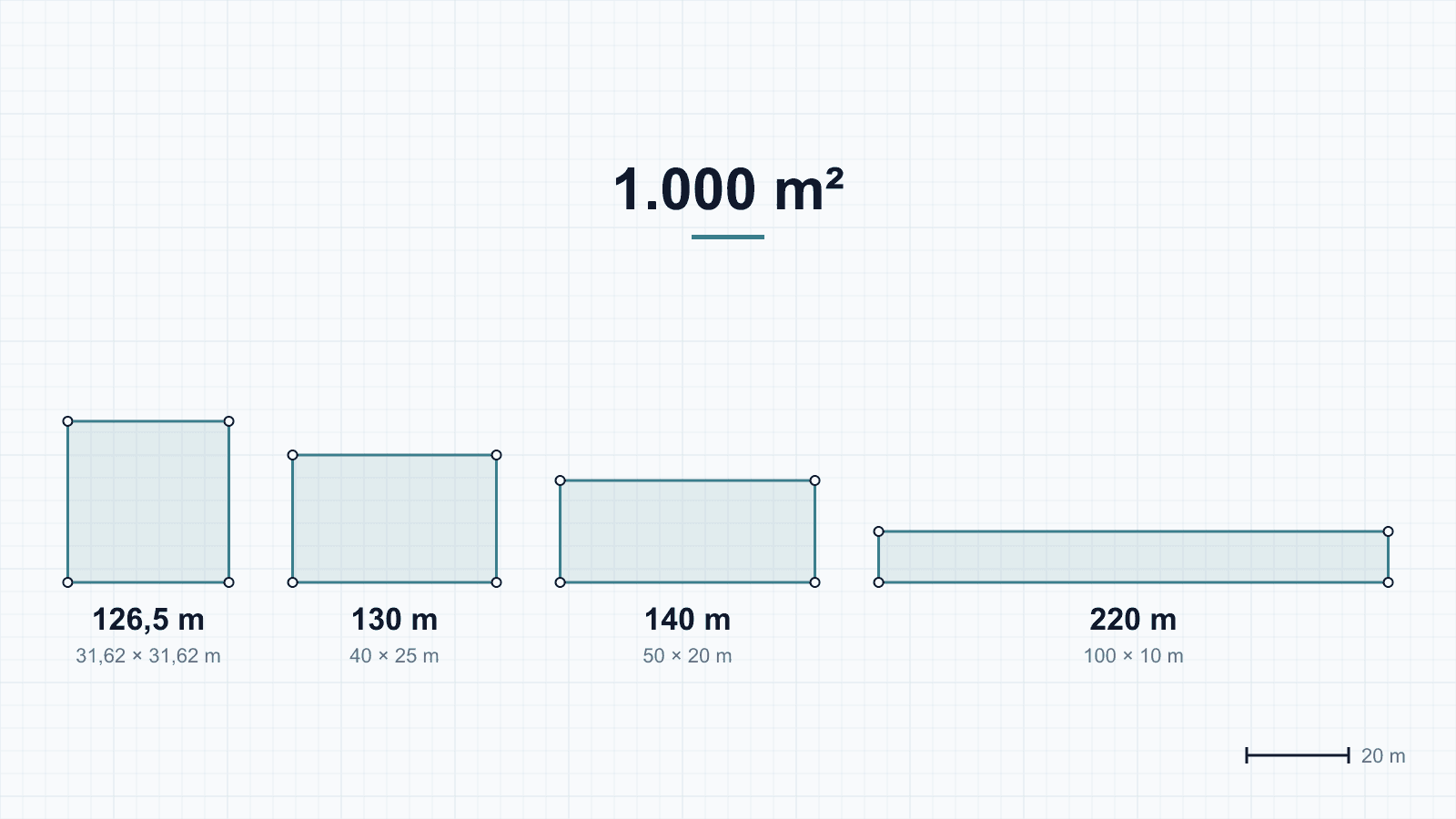
Landowners who contact us about fencing usually start with the same question: "I have 1,000 square metres, how many metres of fence do I need?" There is no single answer, because a fence runs along the boundary, not across the area. The same 1,000 m² plot can need 126 metres of fence if it is square and 220 metres if it is long and narrow. Below we explain how to find the perimeter and how to turn it into panels, posts and rolls, with worked examples.
In Türkiye land is often measured in dönüm; one dönüm is exactly 1,000 m², so the figures below apply directly.
The short answer: 126.5 metres for a square plot
A square plot of 1,000 m² has sides of 31.62 m and a perimeter of 126.49 m. That is the fence length before any gate opening is deducted.
For larger square plots the perimeter grows like this:
| Area | Side of square | Perimeter |
|---|---|---|
| 1,000 m² | 31.62 m | 126.49 m |
| 2,000 m² | 44.72 m | 178.89 m |
| 3,000 m² | 54.77 m | 219.09 m |
| 5,000 m² | 70.71 m | 282.84 m |
| 10,000 m² (1 ha) | 100.00 m | 400.00 m |
| 20,000 m² (2 ha) | 141.42 m | 565.69 m |
One thing stands out: when the area quadruples, the perimeter only doubles. On 1,000 m² there are 0.126 m of fence per square metre; on 10,000 m² that falls to 0.040 m. This is why the fencing cost per square metre drops so clearly on larger plots.
How the shape of the plot changes the length
Even with the same area, the perimeter grows as the plot gets longer. Four shapes of the same 1,000 m²:
| Shape | Dimensions | Perimeter |
|---|---|---|
| Square | 31.62 × 31.62 m | 126.49 m |
| Rectangle | 40 × 25 m | 130 m |
| Long rectangle | 50 × 20 m | 140 m |
| Strip | 100 × 10 m | 220 m |
The shape that encloses a given area with the shortest fence is a circle (112.10 m), but circular plots are rare on a land register. In practice, the closer a plot is to a square, the less fence it needs. A narrow 100 × 10 m strip needs about 74% more fence than a square garden of the same area.
On plots with broken, irregular edges the difference is even larger. A fixed rule such as "so many metres per thousand square metres" is therefore often misleading; the reliable calculation starts from the actual boundary.
How to find your plot's perimeter
- From the cadastre: A title deed states the area but not the perimeter. The corner points of the parcel are recorded in the cadastre, and the perimeter is calculated from them. For plots in Türkiye, our parcel calculator takes the province, district, block and parcel number, pulls the boundary from the land registry (TKGM) and gives you the perimeter and the length of each edge.
- From the mobile app: The Konak Tel Çit app does the same calculation on site. If you do not know the parcel number, it finds the parcel you are standing on from your location.
- With a tape measure: Where there is no cadastral record, or only part of the land is to be fenced, measure each edge separately and add them up. Keeping a note of each edge is also needed for the panel count below.
A small correction for sloping ground
Cadastral lengths are horizontal. On a slope, the length along the ground is slightly longer: 0.5% more at a 10% gradient, 2% at 20% and 4.4% at 30%. On gentle slopes it can be ignored; on steep ones it should be included. On sloping runs the panels are installed in steps.
From perimeter to materials: panels and posts
With panel fencing, the calculation follows the panel width. Our 3D panels and 2D Double panels are 2500 mm wide, with a post at every panel joint.
- Deduct the gate opening. The width taken by the gate comes off the fence length. A 130 m perimeter with a 3 m vehicle gate leaves 127 m of fence.
- Count panels edge by edge. Divide the length of each edge by 2.5 and round up. If an edge is not an exact multiple of 2.5 m, the last panel is cut on site, and the cut panel still counts as one panel.
- Posts are one more than panels. On a closed run the number of posts would equal the number of panels; because the gate opens the run, there is one extra post. Reinforced gate posts to carry the leaves are added on both sides of the gate.
Example: a 40 × 25 metre plot with a 3 metre gate
| Edge | Fence length | Panels |
|---|---|---|
| E1 | 40 m | 16 |
| E2 | 25 m | 10 |
| E3 (gate edge) | 40 − 3 = 37 m | 14.8 → 15 |
| E4 | 25 m | 10 |
| Total | 127 m | 51 |
The result is 51 panels and 52 posts, plus 2 reinforced posts for the gate. Clamps, corner fittings and foundation concrete are covered by the post and clamp calculator and the post spacing and concrete calculator.
Why count edge by edge? Dividing the total length by 2.5 in one go can miss cut panels. A 31.62 m edge, for example, takes 12 full panels and one panel cut to 1.62 m, so that edge needs 13 panels.
Does fence height change the length?
No. The perimeter decides how many panels and posts you need; the height decides how tall they are. Our 3D and 2D Double panel fences are made in heights from 630 mm to 3030 mm. A taller fence means heavier panels and longer posts, but the same count. You can check panel weights with the 3D panel and 2D Double panel weight calculators.
If you use chain-link mesh
Chain-link mesh comes in rolls; our galvanised and PVC-coated chain-link rolls are 25 m long. For 127 m of fence, 127 ÷ 25 = 5.08, so you need 6 rolls. Roll heights range from 1000 mm to 6000 mm. A tension wire is recommended for extra strength. Details are on our chain-link page.
Allow a margin on irregular plots
On a regular rectangle, counting edge by edge already covers the cuts. On irregular plots with broken edges there are more cuts and corners, so adding 5% to 7% on top of the count is sensible. Our mobile app suggests this margin itself, based on the shape of the plot.
The calculation in order
- Find the perimeter from the real boundary: cadastre, app or tape measure.
- Write down each edge separately.
- Deduct the gate openings.
- Divide each edge by 2.5 m, round up and add up the panels.
- Add one to the panel count for the posts, and list the gate posts separately.
- Allow 5–7% on irregular plots.
If you would rather not do it by hand, use the parcel calculator with your block and parcel number, or write to us through the quote form and our team will prepare the materials list.
